
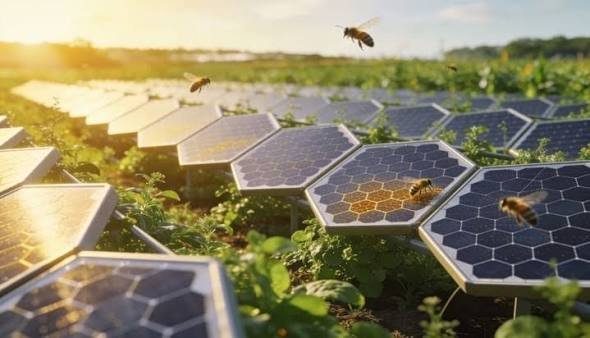
Honeycomb-Inspired Solar Panels
Scientists Turn to Bee-Inspired Design to Make Solar Panels Smarter
What if the future of solar power was inspired by one of nature’s greatest architects—the humble honeybee?
Researchers are exploring an exciting new solar panel concept modeled after the hexagonal honeycomb built by bees. This innovative approach could help solar panels capture more sunlight, reduce energy loss, and generate more electricity—all without making the panels larger.
The idea is rooted in biomimicry, a field of engineering that learns from nature’s most efficient designs to solve modern technological challenges. By borrowing the honeycomb’s remarkable geometry, scientists hope to create solar panels that are more efficient, more sustainable, and better suited to meet the world’s growing energy demands.
Why Rethink Traditional Solar Panels?
Even today’s advanced solar panels don’t capture every ray of sunshine. A small portion of incoming sunlight reflects off the panel’s surface before it ever reaches the photovoltaic (PV) cells, reducing overall efficiency.
That’s where the honeycomb-inspired design comes in.
Instead of relying on a perfectly smooth surface, researchers are experimenting with microscopic hexagonal textures that guide and trap sunlight more effectively.
These tiny structures can:
Capture sunlight from multiple directions.
Reduce unwanted reflection.
Keep light inside the panel for longer.
Increase the chances that sunlight is converted into electricity.
The result? More usable energy from the same amount of sunshine.
How Does the Honeycomb Design Work?
Imagine sunlight entering a maze instead of bouncing off a mirror.
The microscopic honeycomb pattern creates thousands of tiny angled surfaces that redirect and scatter incoming light throughout the solar cell.
Rather than escaping after a single reflection, light is given multiple opportunities to be absorbed.
This process helps:
Redirect reflected sunlight back into the photovoltaic layer.
Scatter light across different angles.
Increase the distance light travels inside the solar material.
Improve energy capture when sunlight is weak or arrives at lower angles.
Known as light trapping, this technique increases the likelihood that more photons are converted into electricity.
The Science Behind the Innovation
 Biomimicry
Nature has spent millions of years perfecting efficient designs. Honeycombs are lightweight, incredibly strong, and exceptionally space-efficient, making them an ideal source of inspiration for engineers.
 Anti-Reflection Engineering
Microscopic surface textures reduce the amount of sunlight reflected away, allowing more light to reach the solar cells.
 Light Trapping
By bouncing light around inside the photovoltaic material, the design gives each photon more chances to be absorbed.
 Multi-Angle Sunlight Collection
Unlike conventional flat surfaces, honeycomb-inspired textures can better utilize sunlight arriving from different directions throughout the day.
Why This Technology Is Generating Excitement
If successfully developed for commercial use, honeycomb-inspired solar panels could offer several important advantages.
 Higher Energy Production
Improved light absorption may enable each panel to generate more electricity from the same amount of sunlight.
 Better Performance in Challenging Conditions
The design could perform more efficiently during:
Early mornings
Late afternoons
Cloudy weather
Diffused sunlight
 Reduced Reflection Losses
Instead of letting valuable sunlight escape, the textured surface helps direct more light into the photovoltaic cells.
 Strong Yet Lightweight Design
Honeycomb structures are naturally known for their impressive balance of strength and low weight, qualities that could inspire future panel designs.
 More Power From Less Space
If efficiency improves, fewer panels may be needed to generate the same amount of electricity, making better use of available land and rooftop space.
Where Could These Solar Panels Be Used?
The technology has the potential to benefit a wide range of applications, including:
Residential rooftop systems
Commercial buildings
Industrial facilities
Large-scale solar farms
Floating solar installations
Building-integrated photovoltaics (BIPV)
Solar-powered electric vehicles
Satellites and spacecraft
What Challenges Still Need to Be Solved?
While the concept is highly promising, researchers still face several hurdles before the technology reaches everyday consumers.
Some of the biggest challenges include:
Manufacturing microscopic honeycomb structures at large scale.
Keeping production costs competitive.
Proving long-term durability under real-world weather conditions.
Integrating the design into existing manufacturing processes.
Demonstrating that the efficiency gains justify the additional complexity.
Scientists around the world are actively working to overcome these obstacles.
Looking Ahead
Honeycomb-inspired solar panels represent an exciting direction in renewable energy research.
Although the technology is still under development, it showcases how solutions found in nature can inspire smarter engineering. If future research confirms its potential and manufacturing becomes cost-effective, this innovation could help make solar energy more efficient, affordable, and accessible.
Sometimes, the answers to tomorrow’s biggest energy challenges aren’t invented from scratch—they’re discovered by taking a closer look at the natural world.
 Key Takeaways
 Inspired by the remarkable geometry of bee honeycombs.
- Designed to reduce reflection and capture more sunlight.
- Uses advanced light-trapping techniques to improve photon absorption.
- May perform better under cloudy skies and low-angle sunlight.
- Could increase electricity generation without increasing panel size.
- Has the potential to support cleaner, more sustainable renewable energy in the future.